
magic, witch, enchantment, luck
writings - magic
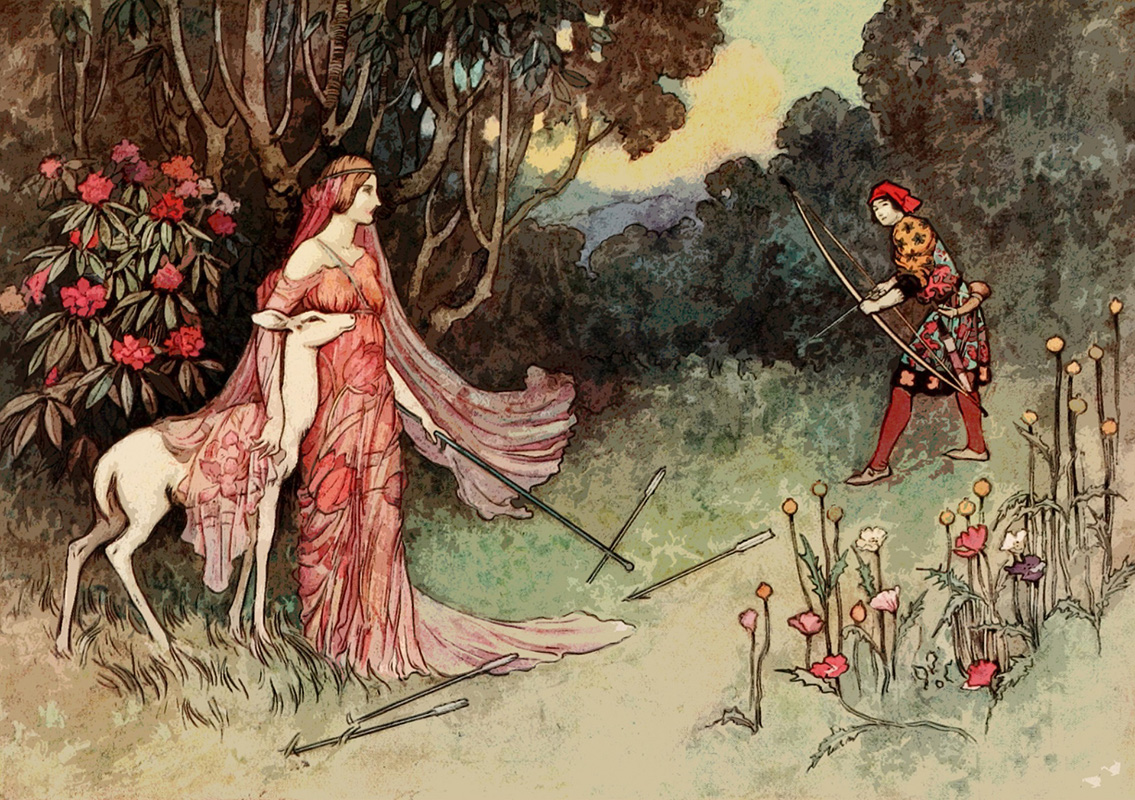
Of Fairies and Iron…
‘By the care of the Fairy Tulip, she as not wounded’
by Warwick Goble (1862 – 1943 British)
Of late, I have been contemplating about the nature of fairies and iron, and how iron has been used to protect against malevolent fairies of all kinds, and how all fairies in general hate iron. This has led to a number of thoughts about iron, what it represents, how it acts, what it means.
History and Practice – Historically, iron in the form of horseshoes, scissors, needles, knives or blades, nails, and even iron filings in water have been used to repel or protect against malevolent fairies. It is usually used at thresholds such as doorways to prevent ill meaning spirits, witches, demons or ghosts from entering…

Celtic Fairy Tales by Joseph Jacobs
‘Irish Fairy Tales’
Illustrated by John D. Batten, Stories Selected by Jennifer Chandler,
I’ve recently been reading a small book of selected fairy tales from a much larger two volume collection by Joseph Jacobs, ‘Celtic Fairy Tales’ and ‘More Celtic Fairy Tales, published 1892 and 1894. The stories include a spectrum of tales, are imaginative, colorful, whimsical and magical. Titles include ‘Connla and the Fairy Maiden’ (illustration below), ‘The Story of Diedre’, ‘Smallhead and the King’s Son’ and similar such. As example, ”The Storyteller at Fault’ is about a storyteller who is supposed to tell the king a new story every night so he can sleep, but runs out of stories. Another story….

The Noble Values, Words to Live By
‘Fairy Islands’
by Ida Outhwaite (1888 – 1960 Australian)
Love, Beauty, Honor, Truth, Compassion, Empathy…
Bravery, Humility, Wisdom, Honesty, Respect…
Trust, Bliss, Freedom, Courage…
Words to live by…
I’ve long thought on, meditated on the impact of words, and the values they carry or express, how they are used, and how they can influence one’s life. In particular, I’ve focused on what I term ‘The Noble Values’ – words that indicate the evolved principles, the higher values of life, words such as Love, as Peace, as Truth – words, values I sometimes think of as the ‘Flowering’ of life, referring to the way they can bring life to blossom…..

The Goddess Brigid
‘The Coming of Bride’ (1917)
John Duncan (1866–1945 English)
The goddess Brigid, is a triple diety of ancient Ireland, with mutltiple aspects, often presented as three sisters. As such, she is simultaneously or at different times, the goddess of healing and protection, the goddess of poetry and wisdom, and the goddess of fire, smithing and war. She is also associated with domesticated animals, the beginning of Spring and planting season,, and the Pagan festival day of Imbolc, the celestial midpoint between the winter solstice and the spring equinox.
Her names means ‘the exalted one’ and has various spellings – Brigit, Brigantia, Bride, Brid, Briginda, Brigdu, and has several modern words associated with these spellings, notably ‘Bride’, ‘Brigand’ and ‘Brigantia’…

The Wild Ride
‘Riddaren’ (Rider)
by John Bauer (1882 – 1918 Swedish)
The Púca is a fairy from older Celtic and Irish origins, with mention also throughout the British Isles. There are a lot of descriptions of encounters with púcai (plural), which can appear in many various shapes, generally animal forms with black or dark fur, but sometimes white also. They are renown shapeshifters, even assuming human figures from time to time. They also are considered both beneficial and menacing, good and bad, bringing both good fortune and ill tidings, depending on the encounter, or in other words, typical fairy mixed values.
Their primary claim to fame is that of appearing as a large, black horse and offering weary travelers a ride along the way, particularly at late evening or night. However, once the rider is seated, the Púca takes off in a wild ride….

Are Fairies Ghosts?
‘Moon Maiden’
Sir Frank Dicksee, P.R.A. (1853-1928 English)
This question arises from time to time, and is understandable as there is a lot of overlap between the two. However, in a short answer and in fairy speak, fairies are fairies, and ghosts are ghosts. They overlap but are not the same, but in some regards, each can be both – the ghost of a fairy, or a fairy ghost.
First let’s consider the differences between the two. To start and most obvious, fairies are alive, and ghosts are dead. While some descriptions of fairies say that fairies are the spirits of the dead, this is a very narrow definition of fairies, if at all. Fairies are many things, and can appear wispy or translucent, even invisible, and there are indeed spirit fairies,..
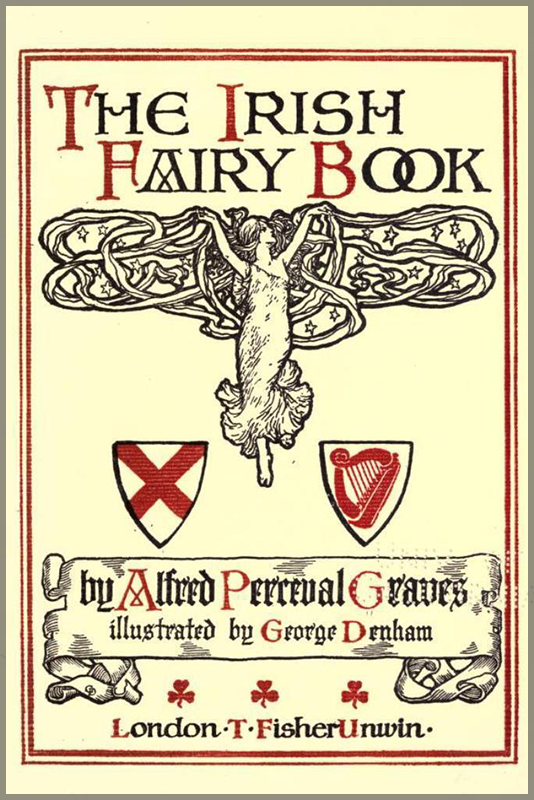
The Irish Fairy
The Irish Fairy Book (1909)
by Alfred Perceval Graves
The Irish Fairy is a large area of study, from the Tuatha Dé Danaan and Aois Sí, to Irish mythology and fairy tales, to the puca and leprechauns. The intent of this article is not to describe the extent of the Irish Fairy, but rather to define the difference between the Irish Fairy and the fairy of Elizabethan and Germanic history.
To begin with, the primary difference is that of origin. The Irish Fairy has a very distinct beginning in Irish history, that being the landing of the Tuatha Dé Danaan on the West of Ireland around 1800 bce, that is – 4000 – 4500 years ago. As mythology describes,…
Earth, Air, Water, Fire – Aether
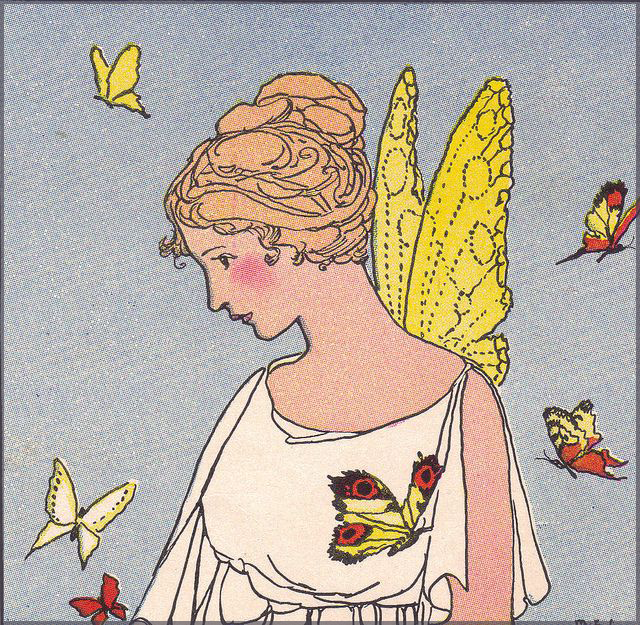
‘Butterflies’ (c 1905)’
Margaret Evans Price (1888 – 1973 American)
Earth, air, water, fire – and aether. The thought of Aether has been a long time meditation for me – what it is, is it is, as it is. Classical interpretation of it, is as the fifth element, the quintessence of the celestial sphere, or as a diety, a primordial god of Roman mythology. Or the personification of light, or energy, or the air the gods breathe, or the omnipresent light that fills the upper sky. In more modern times, scientific theory has held that aether is a hypothetical substance, through which sound travels, or light waves propagate. More modern thought holds that aether is a fundamental quantum or zero point field that permeates the universe, providing a medium for forces like gravity and electromagnetism…

The Fairy Fox, ‘Kitsune’
‘The Moon on Musashi Plain’ (c 1892)
Art by Tsukioka Yoshitoshi (1839 – 1892 Japanese printmaker)
I thought I would take a slight detour from Celtic studies and look at the ‘Kitsune’, the fairy fox of Japan.
The earliest reference to the term ‘kitsune’ in Japan dates back to 794, however there are much older references to magical foxes of all types in ancient Chinese and before then, Buddhist texts and stories. For instance, ‘Fox Becoming Fairy’ is a well known tale from Chinese mythology. Another is ‘The Legend of Fox Fairy Lady’ from ancient Taoism. The essence of these stories is about the journey of a fox becoming a fairy, spirit or immortal or gaining supernatural powers. In China kitsune are referred to as ‘Huli Jing’ in China, and ‘Kumiho’ in Korea…
Of Leprechuans…
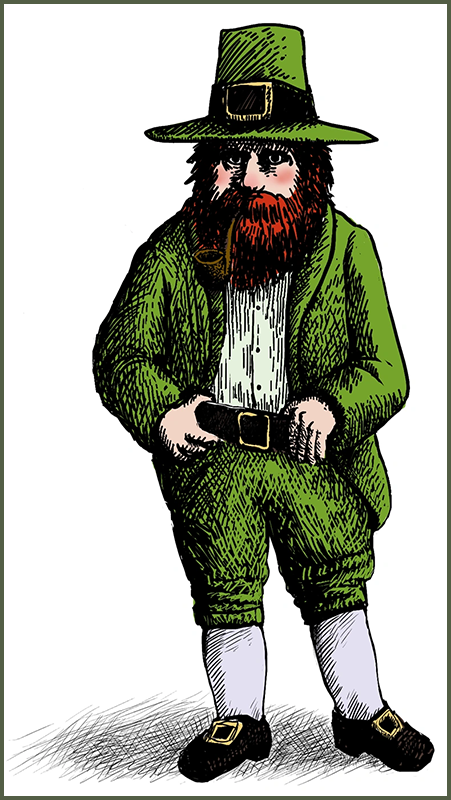
‘A Leprechaun’
Artist **
Leprechuans are a relatively new addition to the fairy family, with the earliest known reference to a leprechaun appearing in a medieval tale ‘Echtra Fergus mac Léti ‘ (Adventure of Fergus son of Léti’), somewhere around the eighth century. After that there is only occasional reference to leprechaun’s in Irish folklore until the eighteenth century, where the figure gained popular attention. Interestingly, the Irish writer William Butler Yeats was a primary influence in promoting the recognition of this character through his overall documentation of fairies in general.
Yeat’s described the leprechaun as a type of solitary fairy, industrious, and mischievous, and as shoemakers who..