
videos, interviews, presentation, discussions
writings - video
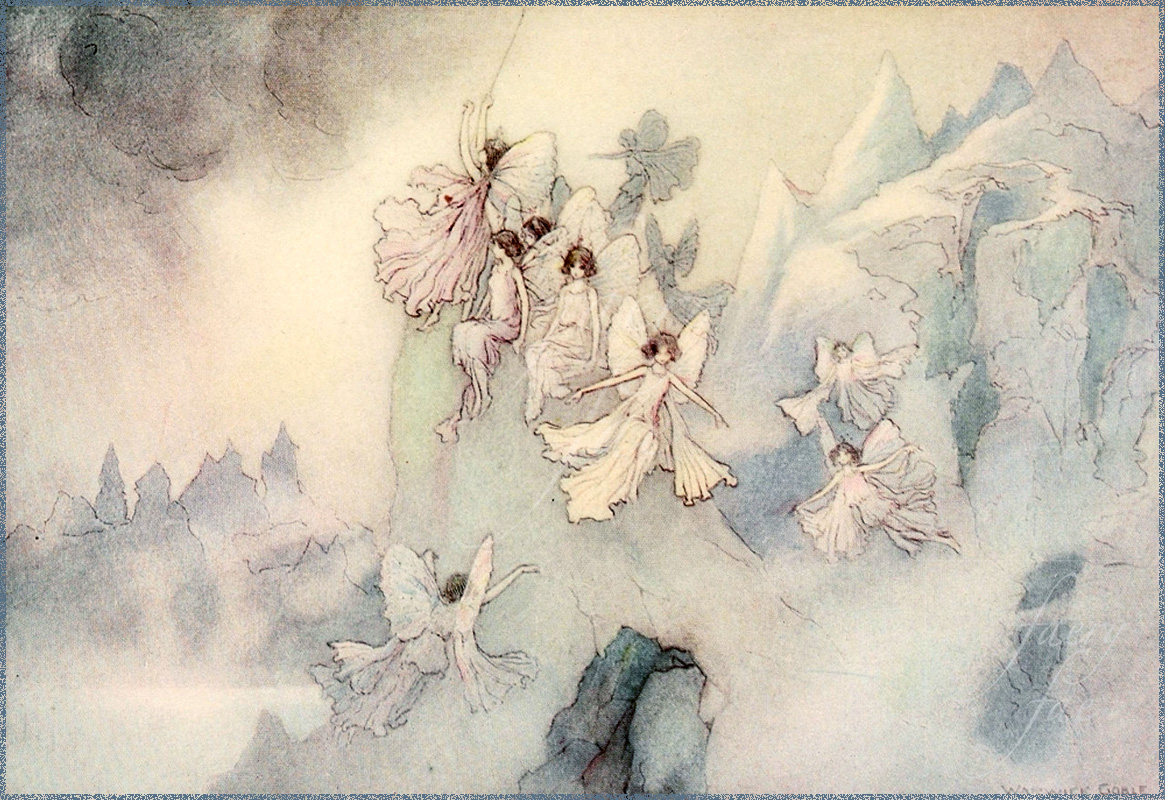
Air Fairies – The Elementals
‘All Around The Ice Cliffs’
Art by Warwick Goble (1862 – 1943 British)
Air fairies are all about wings, flying and freedom. It is a strong elemental aspect to many fairies, as revealed by the name ‘f-air-y. Air fairies, classically known as sylphs, are a class of fairies including any fae with wings. If they can fly, they are air fairies, or at least have a strong presence of this element.
Air fairies, classically known as Sylphs, embody, reflect and express the dominant characteristics of the element air. The word ‘sylphs’ was first introduced by Paracelsus in the early 1500’s as part of his general description of fairies, with ‘Sylphs, corresponding to air’. (Read the introduction to ‘fire fairies’ for a further discussion of Paracelsus and the four (water, earth, fire, air) elements. Also of note, the term ‘sylph’ is derived from the Greek word ‘silphe’, which means a ‘butterfly’ or ‘moth’.

Fire Fairies – The Elementals
‘The Autumn Fairy’ (1919)
Art by Ida Outhwaite (1888 – 1960 Australian)
For some time now for some obscure reason, I have been compelled to write about ‘Fire Fairies’. All fairies are primarily aligned or endowed with characteristics of one of the elementals – earth, air, water, fire – more than the others. It is similar to humans being born under certain horoscope signs. This all hearkens back to the writings of Paracelus (1493 – 1541), who defined fairies are entities of the four elements, described in his own words from his posthumously published book ‘A Book on Nymphs, Sylphs, Pygmies, and Salamanders, and on the Other Spirits’ – Salamanders, which correspond to fire; Gnomes, corresponding to earth; Undines, corresponding to water; and Sylphs, corresponding to air.

The Fae Frequency – Abundance
From ‘Brooke Underwood Energy’
The Faeryfae website offers a wide offering of information related to the fairies, the fae and the faery. Topics include an extensive collection of artwork from the ‘Golden Age of Illustration’ (1850 – 1950) and before, fine art of fairies and fairy-esque imagery from the 1700, 1800 and 1900’s, discussion about Celtic influences, other historical references including Greece, Rome, the Nordic states, Gaul, Ireland, Britain and so forth, compilations of facts and information about fairies, references to videos and writings, stories, imaginings, definitions, links and so on. Also included in this site is the presentation of over 300 cards with positive interpretations of life values – beauty, love, freedom, bliss and similar, and written meditations on those values. The nature of the information included in this collection varies from factual to make-believe, opinion to reference, sincere to playful – basically anything that may shed light on the phenomenon of fairies and for the purpose that one may ‘do what they may’ with that information…
The video is by Brooke Underwood Energy
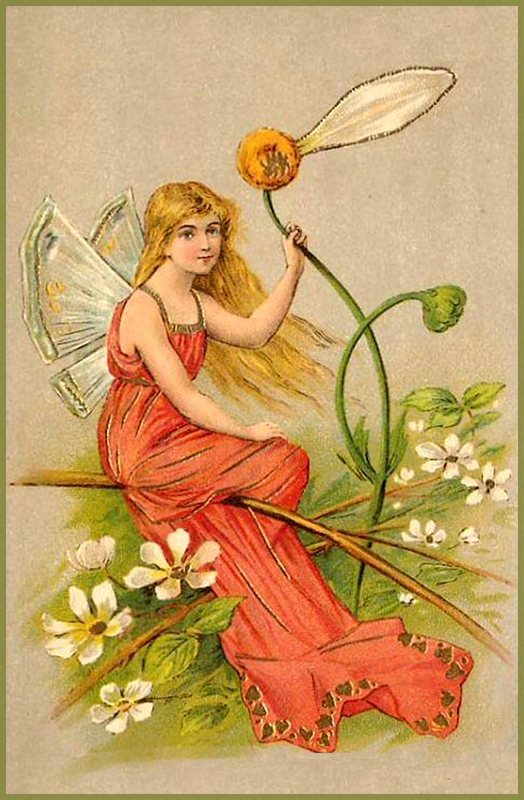
Of Fairies and Daisies Postcards
‘French Postcards of Fairies with Daisies’
Artist(s) unknown (Published c 1910)
This set of postcards displays fairies with daisies, circulated sometime during the period (1900 – 1920’s), probably originating in France. Four of these images are from a set of postcards by the same illustrator. They are whimsical and humorous, imagining fairies with little else to do in a day except take out their love aspirations on the poor little daisies.
‘He loves me, he loves me not!’
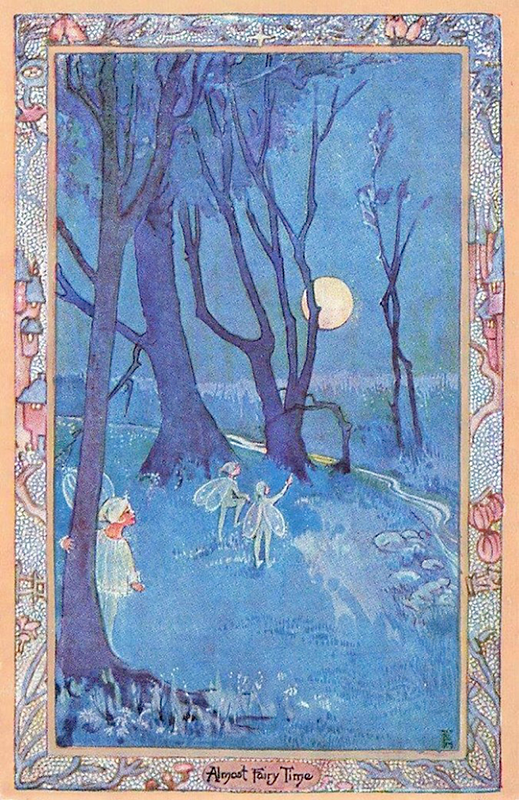
Emma Florence Harrison Postcards
‘Almost Fairy Time’
Vivian Mansell & Co Ltd of London Postcard (Series Published c 1900)
Little is known about Emma Florence Harrison (1858 – ? English), often mistaken for her contemporary Florence Susan Harrison (1877 – 1955 Australian), another and better known fairy tale illustrator. What is known is that she studied at the Glasgow School of Art in the late 1800’s, exhibited at the Royal Academy in London in 1877, and illustrated books of fairy verse (Blackie and Sons) and poetry (Rosetti and Tennyson).

Amédée Varin Engravings (c 1850s)
‘La Vestale du Rio Grande’
Amédée Varin (1818 – 1883 French)
This gallery is from the work of Amédée Varin, a french painter and engraver during the 1850s. These are a series of whimsical illustrations personifying butterflies, from a book titled ‘Les Papillons des Peuples de L’Air’ (The Butterflies, Terrestrial Metamorphoses of the People of the Air) (Published 1852). He came from a long family line of artist / engravers dating back to the 17th century. He worked with two younger brothers, but most of his engraving work was done in partnership with his brother, Eugene.

Samuel Loren Schmucker Postcard Illustrations
‘Red Butterfly Fairy’
Samuel Loren Schmucker (1879–1921 American)
This is a small fairy gallery from the greater work by Samuel Loren Schmucker, a popular American postcard illustrator active during the ‘Golden Age of postcards’, (c 1898-1915), the heyday of postcard popularity. A very prolific artist, he was considered the preeminent postcard artist of the time and genre, and is currently recognized by most as the finest and most collectible American postcard artist from that era.
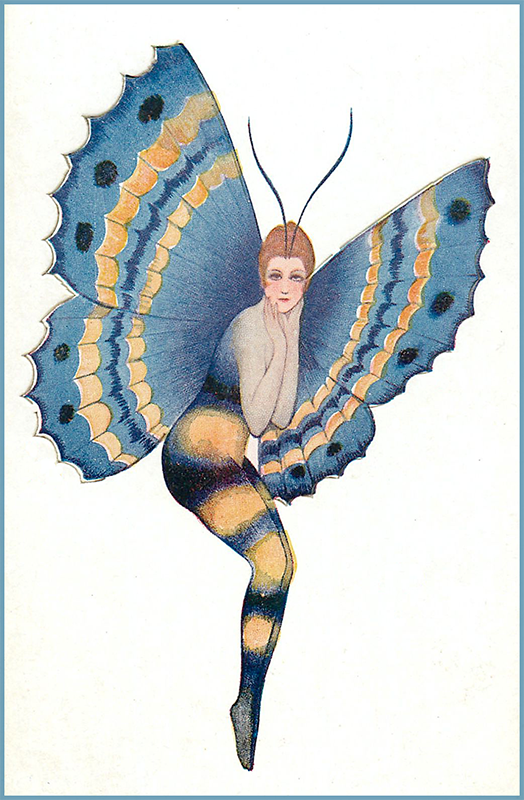
César Giris Fairy Sketches
‘Blue Butterfly Fairy’
César Giris (1877 – 1941 Italian)
This is a small gallery of the work by Cesar Giris, and Italian illustrator (1877 – 1941). Little information about this artist is available, but these six images make a unique gallery. He also illustrated various posters and similar advertising material in the early 1900’s.
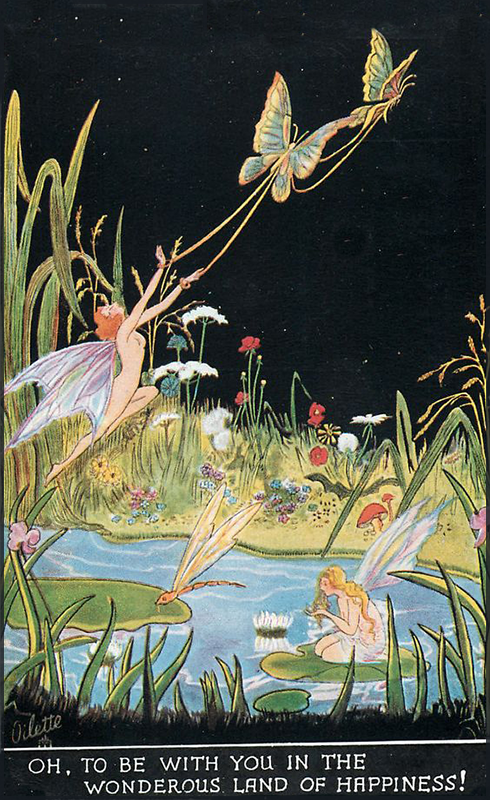
Alice Marshall Postcards
‘Oh, To Be With You In The Wonderous Land Of Happiness!’
Alice Marshall – Tucks postcard (Published c. 1920)
Alice Marshall was a lessor known English artist from the 1920’s. She designed a series of postcards, printed by Tuck Postcards which were printed from 1903 through the 1920’s and 1930’s. Little information about the artist is available, other than the publishing dates of the postcards. The small collection of postcards, two sets of six images, are somewhat unique in that they all work with a black background as a theme. Also the figures in the illustrations are a bit ‘saucier’ than most other fairy illustrations of the time.
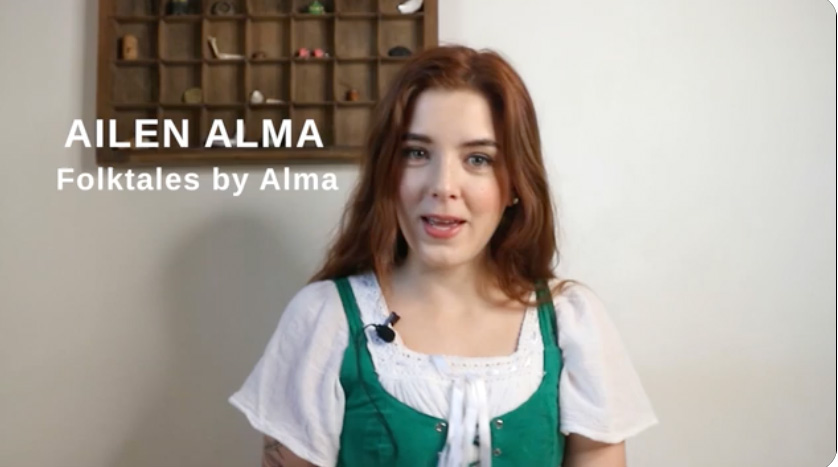
Elves and Fairies Explained – History & Folklore
This video explores the origins of Elves and Fairies. Alma talks about three different origins, Scandanavian, Anglo-Saxon and Celtic of the faerie myth. She also talks at length about the relationship of Elves and Fairies..
The video is by Folktales by Alma