
magic, witch, enchantment, luck
writings - magic

Scary Fairies
The Frog and the Fairy
by Helen Jacobs (1888 – 1970 English)
Not all fairies are nice. Some are scary. And there are levels of ‘scariness’, from those that may give one a fright but are otherwise harmless, to those that are drenched in menace and made from the stuff of nightmares. And worst of all, there are fairies that are beautiful in their allure, and simply deadly in their actions. The Kelpie comes to mind, for example, a Scottish water spirit that inhabits rivers and lochs. It can shapeshift to a horse or beautiful woman or hairy beast, all with the intent to lure the unsuspecting into a watery grave, but not before terrorizing the poor soul. Or maybe even worse, are the fairies that can be both good and evil, to use black and white terms (which faeries are never either) so one never knows where things stand, the slow, soul eating terror of never knowing, like will one love or kill you?

The Black & White Fairy Illustrations of Ida Outhwaite
‘The Hidden Pool’
Art by Ida Outhwaite
I recently created a black & white gallery of fairy images, and while adding various artists’ illustrations of pen and ink, pencil and charcoal work, etching and engravings and so forth, I yet again realized how set apart the work of Australian fairy artist Ida Outhwaite is. Therefore I decided to create a separate article solely about her work and a sample gallery of her black and white images. This is in addition to a previous article ‘Ida Outhwaite – Queen of Fairy Illustrations’ one may wish to read.
Black and white art or photography is an interesting way of seeing things, or the world, as it works with high or low contrast, shadow and shade…

Why Fairies?
‘Listening to the Nightingale’
by Ida Outhwaite (1868 – 1960 Australian)
So why fairies, why the focus, the absorption, the meditation on fairies? This is somewhat of a personal inquiry, asking myself what is so engaging about fairies? Obviously I’ve had a longstanding interest in the topic, and the energy to create this website and discussion. Obviously there is a lot of time represented in the research, writing and image preparation displayed on these pages. So why fairies, what is the sustaining interest, fascination? So allow me some musing, some reflection upon the matter, nothing of any solid answer, but rather just wondering, consideration and meditation…

Who Was Ella Young?
Ella Young, Celtic Poet and Mystic
I ran across the poet Ella Young while writing about about ‘The Coming of Lugh, A Celtic Wonder Tale’. With a background in Celtic mythology, she edited and retold the story with her poetic writing while her close friend Maud Gonne did illustrations for the 1909 published work. After researching her life and times, the description of Wild Woman as from Clarissa Pinkola’s book ‘Women Who Run With Wolves’ comes to mind. Another thought that surfaces after reading about Ella Young is the saying, ‘Well behaved women seldom make history’ by Laurel Thatcher Ulrich (1976).
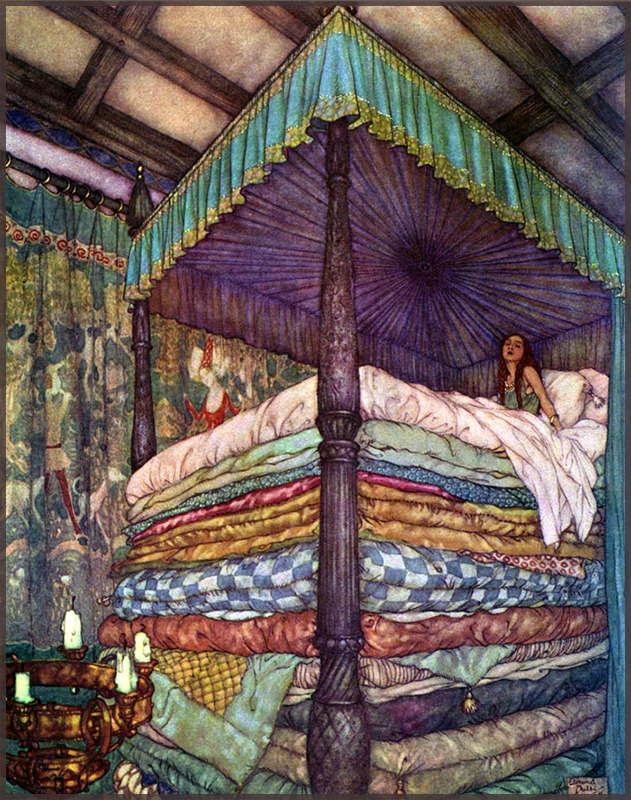
What is a Fairy Tale?
‘The Princess and the Pea’
by Edmund Dulac (1882 – 1953)
Since writing a bit about the ‘Frog Prince’ and ‘The Goose Girl’, I’ve been pondering the question, ‘What is a Fairy Tale’? On the surface, the first answer that comes up is a fairy tale is a children’s story, with magical elements and rooted in oral history, or some such similar answer. Additional aspects of a fairy tale include settings or backdrops of castles or cottages, faraway kingdoms, dark forests or pastures or meadows and similar, and involve archetypal characters such as heroes or villains, kings, queens, peasants, stepmothers, tricksters, or various types of magical helpers.

The Goose Girl
‘The Goose Girl’
by Elizabeth Curtis
(1873 – 1946 American)
After posting about the ‘Frog Prince’, I thought I would do the same about the story of the ‘Goose Girl’, another common fairy tale theme I run often across when looking at fairy tale images. The story was first collected by the Brothers Grimm in 1815 in Germany, and translated into English in 1826. It is a little darker than ‘The Frog Prince’ but still ends up happily in the end.
The essence of the goose girl story goes like this… a princess is sent away by her widowed mother to a distant kingdom to marry. She is accompanied by a servant girl, a magic horse who can speak named Falada, and a special charm to protect her from her mother. Along the journey, the princess asks the servant girl for some water from a nearby stream, but the girl refuses, saying she no longer wishes to serve the princess…

The Frog Prince
”The Frog Asks To Be Allowed To Enter The Castle’
by Walter Crane (1845-1915 British)
There are a number of recurrent fairy tale themes I run across quite often when looking at various fairy tale imagery or otherwise researching fairies in general. One theme is that of the ‘Goose Girl’ for example. Another theme and the focus of this post is that of ‘The Frog Prince’.
I ran across an analysis (below) of the recurrent theme of the ‘Frog Prince’ while looking at imagery of fairy tales, and it piqued my interest in understanding a bit more about the ‘moral of the story’ so to speak.
In essence, the story of the Frog Prince, also referred to as The Princess and the Frog, the Frog King, the Frog Husband and numerous other similar variations, is about a spoiled princess who asks a frog for a favor, retrieving a golden ball accidentally dropped into a pool. The frog agrees to help the princess but only if she allows him to become her companion. She promises…

Fairy Quotes
‘The Frog Prince’ (c 1909, The Fairy Tales of the Brothers Grimm)’
Arthur Rackam (1867 – 1939 English)
Listed below are some selected quotes about fairies, and below a display of quotes and graphics from Pinterest. These quotes and sayings offer nuggets of thought, wisdoms and observations for one to consider, affirm or ponder.
“I want to be magic. I want to touch the heart of the world and make it smile. I want to be a friend of elves and live in a tree. Or under a hill. I want to marry a moonbeam and hear the stars sing. I don’t want to pretend at magic anymore. I want to be magic.” – Charles de Lint, fantasy fiction writer

‘British Fairy Origins’ by Lewis Spence
‘British Fairy Origins’ (p 1946)’
Lewis Spence (1874 – 1955 Scottish)
I ran across this book while researching various ‘fairy quotes’ from various authors and such. I realized from the quotes from this book were about many of the themes and questions I’ve mused about in these writings, such as ‘Fairies as Spirits of the Dead’, ‘Fairies as Elementary Spirits’ and ‘Theories Concerning Fairy Origins’. Therefore and so, I thought I would profile this book as an additional resource for those who seek.
Lewis Spence was a journalist, poet, author, folklorist and occult scholar. His interests spanned across various interests, such as magic arts, spells and charms…

The Inner Fairy
”Wood Nymph’
‘Wood Nymph’
Ludwig Adrian Richter (1803 – 1884 German)
“In each of us there is another whom we do not know” – Carl Jung
If we consider one of the older definitions or meanings of the word ‘fairy’, as simply ‘unknown’, and we apply that to the above, we might arrive at the consideration based on the above quote by Jung – ‘In each of us there is a fairy whom we do not know.’ This might be further described as the unconscious, or the shadow or secret self, or innermost internal. Or an inner awareness or the presence of one’s inner fairy. Or maybe your Anam Cara, one’s soul friend.
Do you feel like a fairy, have inexplicable tendencies, a natural attraction, certain inclinations to natural environments, or animals or plants?