

List of Types of Fae
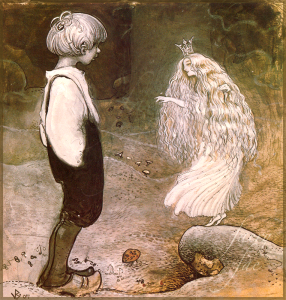
by John Bauer (1882 – 1918 Swedish)
Below is an extensive list of various types of fae with abbreviated definitions and further links for greater description.
Alven – primarily water fairies in the Netherlands, pond fairy, also Dutch word for elves, collective word meaning nature spirits, also messenger fairies – https://dutch-folklore.fandom.com/wiki/Alven
Ashray – ghostlike water fairies, very transparent, avoid sunlight which turns them into rainbows in the water
Ballybog – peat faerie, small, round, frog like dirty fairies found in bogs, also known as Boggies – https://www.startpage.ie/article/the-ways-of-irish-ballybogs/
Banshee – originally from Ireland, a female spirit known for crying, wailing, screaming or keening, said to herald the death of family members or others, can assume different sizes and shapes, smallish, thin, usually dress in grays and greens – https://en.wikipedia.org/wiki/Banshee
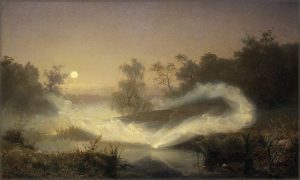
by Johan August Malmström (1829 –1901 swedish)
Boggart – a malevolent house spirit, tend to torment families in uncomfortable ways, ugly humanoid or beast-like type appearance – https://en.wikipedia.org/wiki/Boggart
Bogie – a type of hobgoblin, often scare children – https://britishfairies.wordpress.com/tag/bogie/
Brownie – originally from Scotland, a house fairy who perform various house cleaning chores, can be testy or resentful if insulted, can turn malicious if offended – https://en.wikipedia.org/wiki/Brownie_(folklore)
Centaur – creature with a human horse body, front half human, back half horse, from Greek mythology – https://en.wikipedia.org/wiki/Centaur
Changeling – a fairy left in place of a human child which is stolen, generally of unusual traits such as sickly or undersized, intelligence, physical features such as a beard or long teeth and the like – https://en.wikipedia.org/wiki/Changeling
Clurichaun – cousin to leprechauns, guards wine cellars, like red clothes, only serve families who are good and worthy
Deva – beings of light, spiritual forces behind nature, elementals, can refer to a grouping of similar entities, of a higher intelligence than most fae, related to angels, an evolution, higher than the earth bound beings, diving beings – http://www.vkmaheshwari.com/WP/?p=2668
Dryad – a tree nymph, or nature spirit associated with trees, long lived and shy – https://en.wikipedia.org/wiki/Dryad
Dullahan – an unseelie or dark faerie who is headless and carries its head with it, rides a black horse, malicious, angry and fierce, contemporary description is ‘headless horseman’ – https://en.wikipedia.org/wiki/Dullahan
Dwarf – small people like faerie that are skilled with working with stones, live in mountains, some can make themselves invisible – https://en.wikipedia.org/wiki/Dwarf_(folklore)
Elf – human like fae endowed with beauty and magic, generally near human size, indifferent to humans, good craftsmanship, highest aesthetics of all the fae except fairies, very long lived or immortal – https://en.wikipedia.org/wiki/Elf
Faerie – term used to describe any number of types of fae, such as elves, gnomes, nymphs, mermaids, and similar, either collectively or individually
Fairy – a type of fae generally described as a petite, feminine figure with wings, can be very small, or human sized depending on the fairy, usually good mannered, can do magic, semi immortal
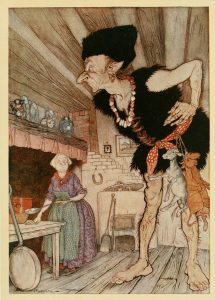
by Arthur Rackam (1867 – 1939 English)
Giant – the largest of the fae, generally humanoid shaped with oversized or grotesque features, usually dim witted, sometimes helpful or well meaning, found in many places – https://en.wikipedia.org/wiki/Giant
Gnome – earth dwelling spirits, shy away from humans, small, live underground, associated with mines and riches underground – https://en.wikipedia.org/wiki/Gnome
Goblin – smallish, ugly creatures of ill temperament, magic abilities including shapeshifting, some are relatively benign, others ill mannered – https://en.wikipedia.org/wiki/Goblin
Harpy – half human, half bird, sometimes elegant with faces of maidens and the like, sometimes menacing with other features, associated with storm winds, wind spirits, insatiable hunger, mostly cruel, violent or dangerous – https://en.wikipedia.org/wiki/Harpy
Hobgoblin – small, ugly male type house fairies similar to pixies or brownies but with a more disagreeable disposition, mischievous, given to practical jokes, sometimes ill meaning or even dangerous, easily annoyed, can shapeshift – https://en.wikipedia.org/wiki/Hobgoblin
Kelpie – primarily Scottish, a shapeshifting creature associated with larger bodies of water, can assume attractive or terrible forms, mostly described as a powerful black horse which can rise above the waves, dangerous to men, can shapeshifter to interact with humans – https://en.wikipedia.org/wiki/Kelpie
Kobold – type of sprite, can materialize into many things, can be invisible if wanted, commonly thought of as looking and dressing like small children, ambivalent nature, can play tricks if upset, house spirit – https://en.wikipedia.org/wiki/Kobold
Korrigan – shapechangers, dwarf or gnome-like creature, evil spirits who like to dance around fountains, but also referred to as beautiful, lustful water sprite faeries who lure men to their deaths – https://en.wikipedia.org/wiki/Korrigan
Leprechaun – type of faerie who holds treasures and gold, dresses in green, somewhat solitary, can be mischievous – https://en.wikipedia.org/wiki/Leprechaun
Merfolk – water dwelling human type fae, including both mermaids and mercreatures, generally half human, half fish – https://en.wikipedia.org/wiki/Merfolk
Mermaid – half woman, half fish, seductive, generally considered of ill omens or outcome but sometimes more favorably disposed towards men, can act as sirens luring ships to tragedy with their songs, often very beautiful – https://en.wikipedia.org/wiki/Mermaid
Nix – water dwelling fae in Germany, generally malevolent, living in lakes and rivers, a sort of mermaid, can change appearance, has gift of prophecy, live in deep underwater palaces, likes music, dance, ‘nixen’ or ‘nixie’ describes the overall group – https://www.britannica.com/topic/nix-German-mythology
Nymph – nature spirits appearing as young, beautiful sexually mature women, nature deities, immortal, generally bound to specific places like ponds, springs, trees and similar, seductive, a type of goddess, also referred to as ‘naiad’ which is a water nymph – https://en.wikipedia.org/wiki/Nymph
Pixie – smallish, childlike beings usually around Irish and English ancient sites such as ring forts and dolmens, of Celtic origin, playful, mischievous, relatively harmless, like dancing – https://en.wikipedia.org/wiki/Pixie
Pùca – Also known as Phooka, Irish shapechanger faerie, goblin, will assume animal (preferred) or human forms, often assumes the form of a horse and takes travellers on wild rides, brings both good and bad luck, tend towards mischief, overall considered both dangerous but can be beneficial – https://en.wikipedia.org/wiki/Puca
Salamander – fire faeries, said to be the strongest elemental faerie – https://www.dandwiki.com/wiki/Salamander_Faerie)
Selkie – a shapeshifting water faeries, known for shifting into seal bodies, can take human feminine forms, seductive, both helpful and dangerous – https://en.wikipedia.org/wiki/Selkie
Sidhe – supernatural race descended from the Tuatha Dé Danann, live in underground kingdoms, fairy forts, spoken of as “The Good Neighbours”, “The Fair Folk”, or simply “The Folk” – https://en.wikipedia.org/wiki/Aos_Si
Sprite – Fairy like elemental entity, element of air, diminutive, ethereal, from the latin word ‘spirit’ (spiritus) – https://en.wikipedia.org/wiki/Sprite_(folklore)
Sylph – an air spirit, an elemental, an airborne nymph, invisible, faerie in the air – https://en.wikipedia.org/wiki/Sylph
Troll – nordic origins, generally ugly, dim witted and ill tempered creatures of humanoid shapes but misshapen features, live far aways from humans, inhabit mountains or rocky places or dark forests – https://en.wikipedia.org/wiki/Troll
Trow – nocturnal, malevolent fae of the outer Sottish islands, sometimes described as giants or smaller human sized, similar to trolls, can be hill or sea dwelling creatures, fondness for music – https://en.wikipedia.org/wiki/Trow_(folklore)
Undine – collective name of elemental water spirits, female, like waterfalls and pools or water, lack souls but can gain one through marriage – https://en.wikipedia.org/wiki/Undine
Unicorn – legendary creature with horse like body and long horn on the front of its head, rare, wild and powerful, magical – https://en.wikipedia.org/wiki/Unicorn
Water Guardian – a type of water fairy that defends its particular domain, associated with the Isle of Man (Mananan Irish God of Sea), a general term referring to the scope of water fairies, can be many forms, including a demon, can cause waves, storms and more, can also refer to any or all water faerie who defends their realm
Will O’Wisp – a ghost light generally seen over bogs, swamps and lakes, elemental spirits – https://en.wikipedia.org/wiki/Will-o%27-the-wisp
Listed above are a collection of names and types of faeries, or more accurately, the term ‘fae’. There are more types, but this is a fairly extensive list of commonly used names for the ‘faerie folk’. In addition to this list, there is also country specific names for other types of fairies based on region, such as Callicantzaroi, Mediterranean goblins, Chin-chin Kobakama, a Japanese house fairy, Domovoi, a Slavic house fairy, Jimaninos, Mexican Trooping fairies, Menehuna, Hawaiian and Polynesian tropical fairies, Rusalki, Russian water fairy, Tomtra, Finnish house fairy, Monaciello, Italian house fairy, Vile, Slavic nymph fairy and so on.
For another complete listing of types of fae with more specific references, please go to https://faeriepedia.weebly.com.
It is an A – Z listing of further descriptions.
Resources
For the most complete listing – Faeriepedia.weebly.com
For further reading and definitions and classifications…