
writings - Blog

About the Faery Fae Site…
‘A Celebration’
‘Art by Ida Outhwaite (1888 – 1960 Australian)
The Faery Fae website is a combination of information, commentary, imagery and interpretation of all things ‘fairy’ or ‘fae’. It is also a resource and archive of information and images for browsing, research and education, and a general consolidation of information and opinion from the overall web. The site is set up to wander through via the menu navigation (writings, galleries and cards), or can be searched by topic, word or name.
There is a growing amount of information about fairies throughout this site, ranging from the Etymology, the study of word origins and evolving meanings, folklore and personal stories, collected facts from various sources, and similar such content. Topics include magic, ettiquette around fairies, practices, history and historical references, definitions and explanations, names and naming, music, biographies and so forth.
About the Faery Fae Cards…
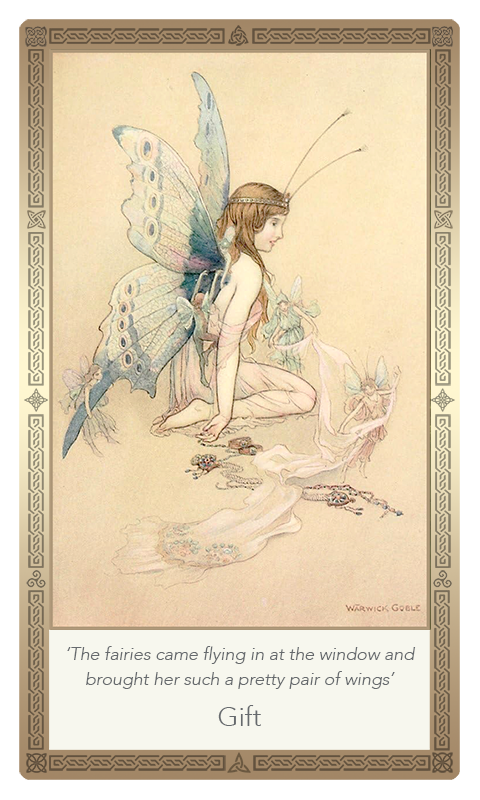
‘A Fairy’
‘Art by Warwick Goble (1862 – 1943 British)
The cards offered on this site via subscription, are small pieces of hand produced art works. Each card is a giclée print, meaning it is printed on acid free 100% cotton rag paper with archival inks. The colors are superior and long lasting. This images are uncoated and meant for light handling, as with any piece of art.
There are a number of ways to collect or work with these cards, which may be referred to as any of the following – as blessing cards, inspiration cards, attraction cards, wild cards, meditation cards, reflection cards, wisdom cards, and any other similar descriptions.

A Timeline of Fairies
‘Nymphe Dansant’
Art by Georges Gabriel Picard (1857 – 1943 French)
Fairies – A Timeline
Some while back while staying on the west coast of Ireland, I sketched out a timeline of fairies across Ireland, Scotland and England. I have since decided to expand the concept of a timeline to discuss the evolution and definitions of the fae, starting back at the beginning of the beginning, and up to the present day. I think this approach may help clarify the changing perceptions, descriptions, language and overall understandings of fairy beings and the fae aspect. Also, of note, that this essay uses the word ‘fairy’ in its widest possible context, in the broadest of meanings.

Walter Crane – Morn, Noon, Even, Nite Painting (Oil on Board 1891)
‘Set of 4 cards based on 1891 painting by Walter Crane (1845 – 1915 English)’
Walter Crane (1845 – 1915 English)
Set of 4 cards based on 1891 painting by Walter Crane (1845 – 1915 English)
Walter Crane was a prolific artist who created illustrations, paintings and designs for a wide variety of publications, galleries and other artistic venues. Examples included children’s books, ceramic tiles, wallpapers, stained glass designs, and other decorative arts such as (fairy) costume designs. He was most active in the 1880’s and 1890’s.
The piece from which the cards are derived is titled ‘Morn, Noon, Eve, Night’ (oil on panel) and was painted in 1891. As the title suggests…
John Anster Fitzgerald – Artist Profile
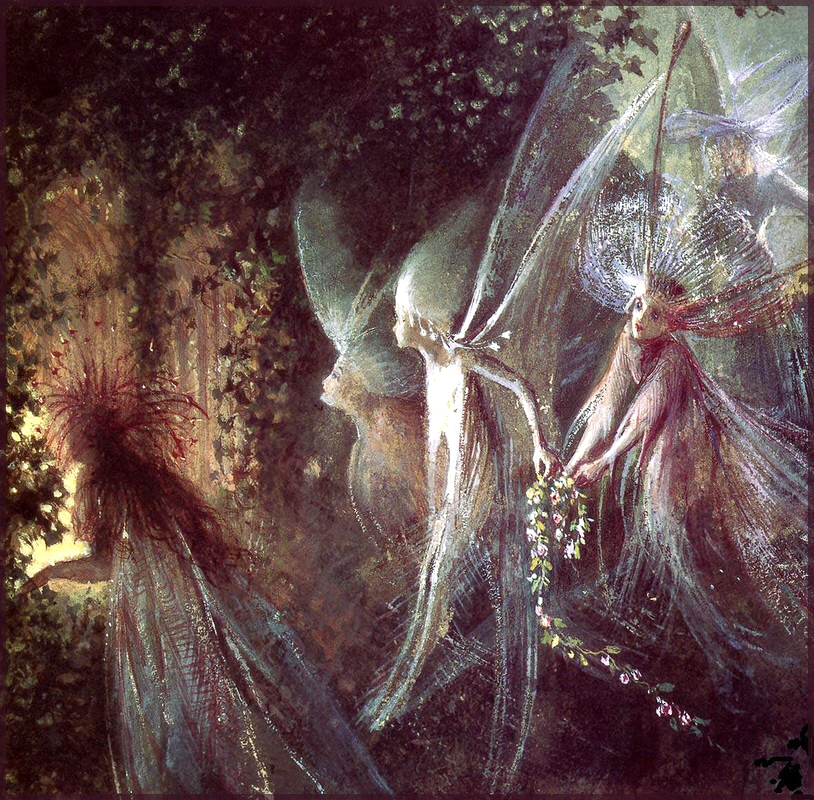
‘Fairies Looking Through A Gothic Arch’
by John Anster Fitzgerald (1819? – 1906 English)
John Anster Fitzgerald (1819? – 1906 English), was a self-taught Victorian era fairy painter and portrait artist. Most of his work focused on complex settings of fairies, ghouls, demons, and the like and often amidst flowers and other garden backdrops. As his reputation and popularity grew, over time he was nicknamed and became referred to as ‘Fairy Fitzgerald’. He was one of the most popular Victorian fairy painters during his time.
He was born in Lambeth, South London, the son of a minor poet William Thomas Fitzgerald, and was of Irish ancestry. In 1849 he married Mary Ann Barr and they raised four sons and two daughters. He was reclusive by nature, and had limited connections with other artists and the art community in general…

John William Waterhouse – Artist Profile
‘Hylas & the Nymphs’
by John William Waterhouse (1849 – 1917 English)
John William Waterhouse (1849 – 1917 English), was an English painter who focused on Greek and Roman mythology, Arthurian legend and the tales from the works of Shakespeare as his subject matter. During the course of his life, he painted some of the most iconic pieces of art depicting fairies (nymphs) and other mythological characters and scenes. He often painted young women in much of his work, but also scenes of ancient legendary events, all with rich oil colors and attention to detail. His paintings have a heavily romanticized look and feel, with deep colors and somber expressions.
Examples of the themes…
.
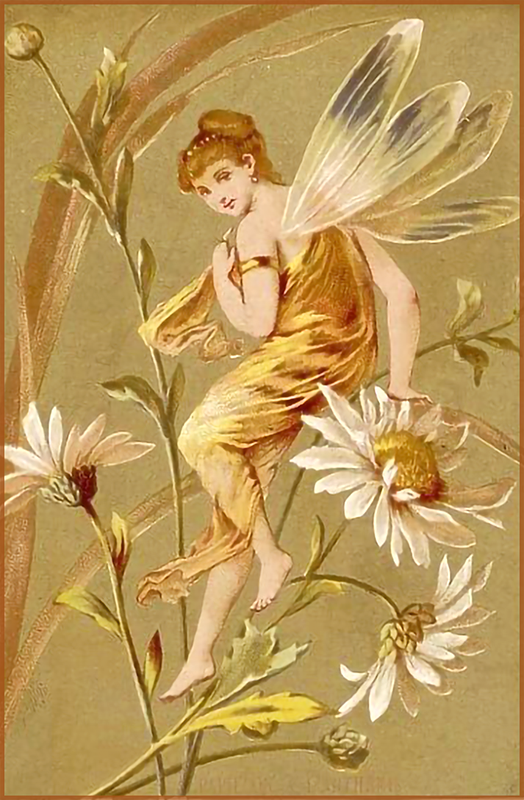
Six Golden Fairy French Trade Cards
‘Fairy Trade Cars with Gilded Backgrounds’
Trade Cards printed circa 1870- 1900 (France)
Displayed below are a set of Fairy trade card illustrations set against a gold background, a technique called chromolithography. The gilded background is a unique technique which gives the cards a regal effect, accentuates the fairy figures and overall creates a pleasing magic about them. As such I present them here because of their rich feel and striking appearance.
These cards were originally printed as a vintage trade card set of 6 in France circa 1870 – 1900…
Of Fairies and Iron…
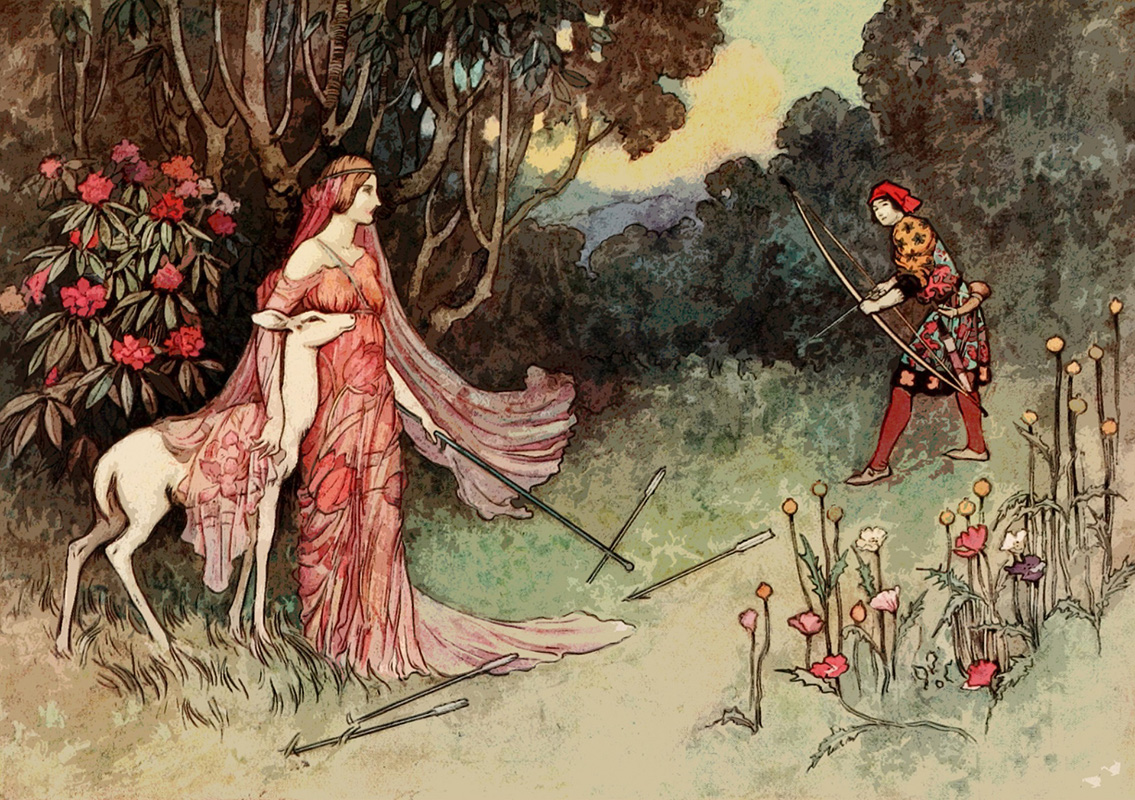
‘By the care of the Fairy Tulip, she as not wounded’
by Warwick Goble (1862 – 1943 British)
Of late, I have been contemplating about the nature of fairies and iron, and how iron has been used to protect against malevolent fairies of all kinds, and how all fairies in general hate iron. This has led to a number of thoughts about iron, what it represents, how it acts, what it means.
History and Practice – Historically, iron in the form of horseshoes, scissors, needles, knives or blades, nails, and even iron filings in water have been used to repel or protect against malevolent fairies. It is usually used at thresholds such as doorways to prevent ill meaning spirits, witches, demons or ghosts from entering…

Celtic Fairy Tales by Joseph Jacobs
‘Irish Fairy Tales’
Illustrated by John D. Batten, Stories Selected by Jennifer Chandler,
I’ve recently been reading a small book of selected fairy tales from a much larger two volume collection by Joseph Jacobs, ‘Celtic Fairy Tales’ and ‘More Celtic Fairy Tales, published 1892 and 1894. The stories include a spectrum of tales, are imaginative, colorful, whimsical and magical. Titles include ‘Connla and the Fairy Maiden’ (illustration below), ‘The Story of Diedre’, ‘Smallhead and the King’s Son’ and similar such. As example, ”The Storyteller at Fault’ is about a storyteller who is supposed to tell the king a new story every night so he can sleep, but runs out of stories. Another story….

Jessie Marion King – Artist Profile
‘Wild Hemlock’
by by Jessie Marion King (1875 – 1949 Scottish)
Jessie Marion King (1875 – 1949 Scottish), was born in 1875 in Bearsden, Scotland, a suburb of Glasgow,, the youngest of five children. Her father was a minister and her mother the daughter of a prominent banker. She grew up in the care of a housekeeper and governess Mary McNab, whom she came to regard as a second mother.
At the age of 17, as part of her formal education, she enrolled in the Glasgow School of Art, where she showed a natural talent for drawing, and where she continued to study and later taught. After her time there, she won a scholarship to study in France and Italy. In 1898 she won a silver medal in the South Kensington annual competition, and in 1902 a gold medal for book design at another competition, the Turin exhibition. As recognition grew of her work across Europe, she started being commissioned to illustrate books with her distinctive, recognizable style. Over the course of her career, she illustrated or decorated over 40 books between 1898 to 1949…
.

Trade Card Fairies
‘Liebig Company’s Fleisch Extract Butterfly Girls’
by Louis-Théophile Hingre (1832-1911 French)
During the late 1800’s and early 1900’s, many companies offered collectible trade cards as incentives to purchase their products. This advertising strategy was originally developed by Albert Poulain in the 1880’s. The strategy was to offer ‘sets’ of collectible trade cards that could be gathered by buying a company’s products and the included trade cards.
Trade cards sets included all kinds of topics, from illustrations for fairy tales, to historical figures and events, the the alphabet, animals and nature, and so on including fairies. Company products marketed via this strategy ranged from chocolate to baking soda to meat products…

M. T. (Penny) Ross – Artist Highlight
‘Woodland Faerie’
by by M. T. (Penny) Ross (1881 – 1937 American)
Marion. T. Ross (1881 – 1937 American) affectionately nicknamed ‘Penny’, was a popular comic artist and children’s book illustrator from the early 1900’s. During his early career he lived in Oak Park, Illinois and owned a studio (Penny Ross Advertising Company) in downtown Chicago. in 1926 he moved to Southern California where he worked as a co-worker with Walt Disney, and also as a set designer for several area studios until 1937, the year of his death at the age of 56….
.

The Noble Values, Words to Live By
‘Fairy Islands’
by Ida Outhwaite (1888 – 1960 Australian)
Love, Beauty, Honor, Truth, Compassion, Empathy…
Bravery, Humility, Wisdom, Honesty, Respect…
Trust, Bliss, Freedom, Courage…
Words to live by…
I’ve long thought on, meditated on the impact of words, and the values they carry or express, how they are used, and how they can influence one’s life. In particular, I’ve focused on what I term ‘The Noble Values’ – words that indicate the evolved principles, the higher values of life, words such as Love, as Peace, as Truth – words, values I sometimes think of as the ‘Flowering’ of life, referring to the way they can bring life to blossom…..