

3 Interpretations About the Tuatha Dé Danaan
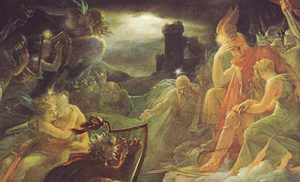
by François Gérard (1770–1837 French)
About the Tuatha Dé Danaan,
The ‘folk of the goddess Danu’,
also known by the earlier name Tuath Dé, ‘tribe of the gods’.
The Tuatha Dé Danaan (pronounced Thoo-a day Du-non)
Overview – When reading and researching about the Tuatha Dé Danaan, who were one of the earliest settlers in ancient Ireland, one eventually realizes that all discussion is two things. One, that everything is pure speculation based on myth, stories that have evolved over time from events that happened a very long time ago. There are only a couple of things that can be surmised with any sort of conviction, that a tribe of people landed on the western shores of Ireland (Eire) and that they had a significant impact on forming the Irish history and identity, for whatever reasons. The second thing that arises is the observation that all discussion about the Tuatha Dé Danaan is hopelessly confused and overlayed with simultaneously descriptions of being a tribe of people, gods and goddess, and faeries, The Aos Sí, the Sidhe.
Below are several interpretations (speculations) about the Tuatha Dé Danaan, presented from each of these perspectives in an attempt to clarify further discussion or commentary. The interpretations are as follows, as a tribe of people, as a superior race of beings described as gods, and as faeries, The Aos Sí, the Sidhe.
Interpretation 1… As a people
Story myth describes six ‘waves’ or ‘invasions’ of people settling on the western coast of Ireland as the first significant populations to attempt to establish themselves around 2500 -1500 bc (or bce – before common era). The first group (following Cesar, daughter of Noah) died from malnutrition and disease, the second group(s) ( Partholón, Nemad, both descendants of Noah) and third group the Formorians died from disease and conflict with each other. The fourth invasion were the Fir Bolg, speculated to be slaves from Greece, and descendants from the remnants of the earlier settlement attempts, who were successful in surviving and growing their population. The fifth invasion was the Tuatha Dé Danaan, described as a superior tribe of people with refined crafts and weapons and who fought against the Fir Bolg and won. Finally the 6th and final wave was the Milesians, or Gaels from nowadays Spain.
In the above described context, the Tuatha Dé Danaan were a tribe from most probably another part of the Mediterranean and brought with them superior skills in terms of craftsmanship and knowledge from another part of the world, which appeared to the Fir Bolg, who were already there, as magical since they had no comparable refined crafts, skills or weaponry. In that usage of the word ‘magic’ it would have simply meant, unexplainable, different without reference. In the conflict with the Fir Bolg which followed the settlement of the Tuatha Dé Danaan, after the defeat of the Fir Bolg, the Tuatha Dé Danaan allowed the remaining tribe to claim ‘Connaught’ as their land. Living side by side then, trade and intermarriage would have transpired over time and the peoples and bloodlines and knowledge would have intermingled.
The sixth wave of invasion was the Milesians, the Gaels and they conquered the Tuatha Dé Danaan, which meant they were subjugated and lost the ability to ‘rule’ then day Ireland, which the Milesians assumed. Most likely the Milesians were able to achieve victory through numbers and perhaps more advanced military tactics. In this scenario, once the warring was over, the intermingling between tribes would have continued and the fundamental bloodlines or Ireland were then established, as that combination of tribes and interactions became a sustainable and growing population.
Interpretation 2… As gods and goddesses
In this interpretation, the Tuatha Dé Danaan arrived as superior beings, from the sky, or magically from a seaborne mist, and by all accounts were only to be described as gods and goddesses, as their beauty, weapons and magics left no other descriptions. Some descriptions have even gone so far as to suggest they were extra terrestrials, from the stars, truly alien by all accounting. In any case, they quickly evolved into the Irish Pantheon of Gods and Goddesses, moving between worldly involvements and the heavens and other hidden realms. Characteristics ascribed to them were immortality, otherworldly beauty and light, magic powers and so forth.
From this loftiness, an entire Pantheon was created by time and story, with Dagda as the great god, The Morrigan as the great queen, and others such as Boanna, Lugh; Nuada; Aengus; Brigid; Lir; Manannán; Dian Cécht the healer; and Goibniu the smith and so on. They were also described as kings, queens, bards, warriors, heroes, healers and craftsmen in their worldly activities and interactions with the world of men, but always with supernatural powers. They possessed magic tools, weapons and musical instruments, but were subject to the same weaknesses of men such as jealousy, anger, love, lust and all the great emotions and subsequent reactions.
The Irish gods and goddesses, the Tuatha Dé Danaan were also assigned to the earth and its elements, as islands, mountains, provinces, rivers, springs and so forth. The River Shannon is named after Sionnan, the granddaughter of Manannán Mac Lir (Son of the Sea), the river Boyne from Boanna, wife of the Dagda, Lir, god of the sea, and even name Ireland itself from the wife (Ériu) of one of the last Tuatha Dé Danaan rulers of Ireland. As Ireland slowly changed with time from Neolithic (quasi aboriginal) to Celtic (immigration from Europe), and due to the earth based religions of the Celts, this pantheon and naming was easily adopted and naturally blended into their own belief systems.
It should also be noted here, that the Celts did not arrive in Ireland until around the 500 – 600 bc (bce). The Tuatha Dé Danaan were pre-Celtic, people of neolithic times. This also suggests that either the Tuatha Dé Danaan ruled Eire until that time (500 bc) rather than the commonly stated dates of 1900 – 1400 bc, or the (Milesians) Celtic people arrived much earlier than 500 bc.
As conclusion, by the considerations above, the Tuatha Dé Danaan were never a reality as a migrating people. Instead as arriving gods and goddesses, a myth starting as story amongst neolithic times, and growing over more time. And that story changed as the (Tuatha Dé Danaan) gods and goddesses adopted the land and the land changed them creating a blending of identities which virtually made them indistinguishable from each other.
Interpretation 3… As fairies
The interpretation of the Tuatha Dé Danaan as faeries is sort of a middle road between the two above descriptions as people and as gods. It can also be interpreted as an allegorical explanation about the evolution of early Éire. Many stories describe the Gods and Goddesses, the Tuatha Dé Danaan as descending into the earth into magical realms or hidden places as they retreated before the Milesians.
The basic description is something like this, that the Fir Bolg and Fomorians represent older, cruder forms of evolution, even as evil or forces of darkness, and the Tuatha Dé Danaan represent ‘enlightenment’ as the powers of knowledge and skills and greater values, the forces of light, came into the world. Further on, in the conflict with the Milesians, the Gaels represent the greater world of modern thought as waves of Celts started to migrate into Ireland, and the original less educated populations were slowly absorbed into the growing influence of the Celts, hence slowly becoming ‘less’, a shadow people, invisible, living in hidden realms, under the earth or sea. In this way the Irish mythological Gods and Goddesses were preserved, becoming entities of the land, faeries, or living in the faery realm, as the world of men grew around and above them.
It should also be noted how the Irish culture sees faeries. They generally do not see them as the winged, feminine fairy broadly illustrated in British and European art from the 1700 – 1950’s and today, but rather as a more troublesome set of incarnations, like spirit beings, and darker elements, gnomes, goblins, leprechauns, and generally less likable forms. Even beautiful faeries in Ireland are viewed as dangerous in their allure. The whole conception of faeries in Ireland is more seen as the entire spectrum of fae, with a few winged garden pixies thrown in, piquant little creatures. The whole faerie myth in Ireland is closer to the original meanings of fae, meaning different and unexplainable, suspicious, and the Irish culture in past times was generally less educated, more isolated than the greater European cultures around them, hence the greater belief and cultural space for the faeries, even in modern Ireland today. It helped explain much of what they did not understand, and a convenient place for their gods to abide. The curious thing about the interpretation of the faeries in Ireland is how deep it goes, and how sustained that belief is behind the veneer of modern Ireland. It is not uncommon to hear the phrase, ‘don’t want to tempt the fates’, or general acceptance of any mention of faeries as explanation.
Conclusion
The truth of all this lies permanently obscured in the veils of time, but is some mix of all the above. There is a host of information available, much further information about the Irish Pantheon and stories, about the faerie realms and more stories, and historic, science based observations. All of it is true as true can be when looking back five thousand years in human time and where nothing was written down until about 1000 ad, thousands of years after the original events. The takeaway of this might be the following observations, that the faerie myth was established in Ireland with the Tuatha Dé Danaan, that something significant in terms of time or occurrence happened which gave birth to that myth, and that the Faerie myth of Ireland is the strongest story about faeries in the world. Other than that, there are parallels to other older myths and religions, the Greek gods, the recurrence of threes (the fates), magic or exaggerated feats or descriptions and so on. In certain lights, belief in faeries is no different than the beliefs in any religious system or existential explanation, and available to be interpreted in any which way as one may want.