

The Tuatha Dé Danaan

John Duncan (1911)
About the Tuatha Dé Danaan,
The ‘folk of the goddess Danu’,
also known by the earlier name Tuath Dé, ‘tribe of the gods’.
The Tuatha Dé Danaan (pronounced Thoo-a day Du-non) were an ancient tribe inhabiting the West Coast of Ireland from about 1900 bc to about 1400 bc, and are the source of both the Irish Gods and the origin of fairies. Below is a retelling of their story, one shrouded in myth, contradiction and imagination, and without doubt, much embellished by centuries of telling and retellings by the oral culture of early Ireland. This essay is also based on a timeline I created over a month spent on the west coast of Ireland, as I researched and pieced together various resources.
The first people to arrive in Ireland were nomadic Hunter Gatherering tribes around 7000 bc. which were following the retreat of the latest Ice Age which covered most or all of Ireland about 10,000 bc. These were the aboriginals of nowaday Ireland, the original people. Over the next 5000 years bc, these small populations grew and fell with natural disasters, disease, conflict and similar conditions. Then about 2000 bc the first of a series of more sizeable groups of settlers arrived, sometimes referred to as ‘invasions’, and began with the arrival of the Cessairs, led by the granddaughter of Noah (Cessair) seeking to escape the foretold coming of the biblical flood. Despite their efforts, it is said the Cessair tribe, numbering some hundreds perhaps somewhat more, did not endure, succombing to the great flood and leaving only one survivor, Fintán mac Bóchra, who lived unnaturally long and in myth is known as Tuan, the White Ancient. Living as first man then beast, as a Great Stag, then Black Boar, then Sea Eagle, then again Man, it is by this mythical figure’s retelling that records these times past and the full story of the Tautha de Danaan, are known. Tuan also weaves himself into the story of Ireland, saying, ‘I am legend incarnate, I am memory turned myth’, so by some interpretations, Tuan the White Ancient is the story of Ireland.
The second invasion of the Isle then known as the ‘Noble Land’ was lead by Partholon, another descendant of Noah, some three hundred year later. Again the settlers, numbering perhaps to some hundreds or thousands, did not prosper instead succombing to disease and attack from the seafaring Formorians, yet another ancient tribe, probably originating out of Spain, Portugal and across the Southern sea now known as the Mediteranean. They were a dark skinned people, and had settlements elsewhere outside of Ireland but raided it frequently, and were a constant threat.
After another 30 years another wave of people arrived to settle in Ireland known as the Nemedians, led by Nemed, a great grandson of Partholon. However they too experienced difficulties, particularly continued conflicts with the Fomorians. It is said that their final defeat was at the hands of the chief Formorian warrior, Conann the Conquerer. In a series of three battles at a place later named the Battle of Conann’s Tower, the two sides utterly destroyed each other, forcing the remaining peoples of both sides to leave the Isle as refugees, with some going as far away as Greece and Syria, and experiencing slavery, corruption and discrimation, while others fled to the isles and lands north, east and south. It is said, Nemed’s own son, Fergus the Half Red, named the land to which he fled after his own son – that being called ‘Britain’. After some two or three or four hundred years, the descendants of some of these peoples cast to the winds, escaped their predicaments and managed to return and settle again in Ireland in communites as farmers with agricutural based lifestyles. The banded together and called themselves the Fir Bolg (the ‘Men of Bags’, possibly referring to a past as slaves carrying loads, but now interpreted as ‘Men who swell up – with battle fury’). Regardless, they lived in relative unmolested peace for nearly forty years, establishing the frameworks of kingships, districts and justice, until the arrival of the Tautha dé Da Danaan, Ireland’s most mysterious invaders.
The arrival of the Tuatha De Danaan is described as mystical, either in great ships from the skies that plowed the clouds as water, or mysteriously out of a great mist that enshrouded the land, sea and sky as one. It is also said they burned their ships so as to remove any doubt or option of leaving their newfound land. Regardless of origin, it was immediately known they brought with them great skills that could only be described as magic to the Fir Bolg. Noted among their great magic, they brought the Stone of Fal (stone of destiny), The Spear of Victory (which always threw true), the Cauldron of the Dagda (a vessel forever full of food), and the Sword of Light.
Legend has it that the king of the Fir Bolg (Eochai, Son of Erc), sent his greatest warrior (Streng) to meet with the newcomers and gain understanding of their intent. The king of the Tuatha De Danaan, Nuada, upon seeing the lone warrior outside the newly built fotifications, sent his own great warrior Lugh to discuss things. In meeting both warriors gained an admiration of each other and their weapons, even exchanging them to appreciate them further. Being of true warrior spirit they complemented each others arms, the Fir Bolg swords and shields being stongly cast and capable of great force, the Tuatha De Danaan weapons being highly refined, lighter and quick. Both Stren and Lugh appreciated the great harm each others weaponary could do, and in mutual respect expressed friendship between the two regardless of the kingships, and the meeting was a foretelling of what was to come between the two tribes.
Lugh then stated that the Tuatha De Danaan came in peace and wanted half the island as their settlement. Bren agreed that there should be no conflict in such a rich and vast land, and said he would relay the request. Upon hearing of this discourse however, the king of the Fir Bolg Eochai, ruling from the inland Hill of Tara, where all parts of Ireland could be seen, disagreed and said the Fir Bolg would not share the Isle. He called up the various clans under his leadership and told them to assemble so as to repel the Tuatha de Danaan back into the sea.
Meanwhile Nuada, king of the Tuatha de Danaan, saw that no further indications of peace and welcome was forthcoming, so moved his fortifications to a stronger defensive position and readied for war. Next, deciding on offensive rather than defensive action, he took his warriors to the Hill of Tara, the seat of power of anceint kingships, and over the course of four days, starting with horns and sport and finishing with horrendous bloodshed, they fought the Fir Bolg.
In legend and myth, the battle is described as supernatural between a thousand heroes, a fight between gods, between gods and men, and between men. The first day of battle the Tuatha De Danaan called upon their three War Witches, the Babd, goddesses of battles – Macha, Morrigan and Neman, who darkened the skies and brought down great fear upon the Fir Bolg. They filled the air with Banshee screams, the wind with an army of nightmares and the clouds with black rain, putting terror deep into the hearts of the enemy. Then in the midst and backdrop of this mayhem, they called up Carnun, the God of Nature, also known as the Horned God, amidst a green errie glow, to complete their terrible army.
However the Fir Bolg were brave warriors and stood their ground preparing for the coming conflict. In the midst of this, the Fir Bolg king Echoia ordered his master Druid Cesar to counter the Babd. To do this Cesar called forth all manner of ancient magic to repel the war witches, using runes and spells and incantations, but only managed to create a limited umbrella of respite from the horror all around the Fir Bolg. In desperation, and upon orders from the king, Cesar then invoked the ancient calling of the Crom-Cruach, the Elder God, the Great Worm, knowing that it would ultimately exact a terrible cost. After creating a circle of marked stones and forgotten language, he created an opening through which Crom-Cruach erupted into the sky, banishing the wraiths of the Babd, washing the sky of its terrors, driving down and away Carnun his ancient enemy, and causing the War Witches to flee knowing they were outmatched. And with that, the Fir Bolg attacked.
True to the understandings of the two great warriors Streng and Lugh, the meeting of each side’s weapons of war and wills of men was mutual slaughter beyond telling. It is said at the end of the day, which inflicted great loss and deep suffering of both sides, the Fir Bolg built a mound of heads from the fallen enemy that the Tuatha De Danaan could see from their nighttime camp. Taller than the warriors who stacked the grim carnage, it stood to remind them thoughout the night of the coming morning and to the return of screams, and blood, and death.
The second day the battle resumed, between the two sides of equal strength with no clear victor and even advantage. Back and forth, like a great writhing worm the battle line moved this way and that with neither side able to establish an advantage. Meanwhile during all this, the Babd backed by Carnun and Crom-Cruach continued their eternal struggles around them, in the sky, making the earth shiver and shudder, with fears washing over all sides like heavy waves. Again after another terrible day, the losses were measured in fallen heroes, multilated bodies and stacked heads, which the opposing sides tossed back and forth in mutual taunt, anger and hatred.
Again, the third day of the battle brought neither solace nor hope nor any advantage of any kind for either side, with victory held only momentarily as sand through fingers. Again the bodies fell one atop another as losses mounted, despair grew like a gathering storm, and the air above raged in continuous vicious fight. Looking around in growing horror, two of the sons of Nuada and Echoia, Lughai and Slaine – each commanding opposing forces reached a stalemate and mutually agreed to cease attacking each other, so many brave warriors lay strewn between them, a wastage of life they could no longer accept. Elsewhere in the ongoing battle, in desperation Cesar of the Fir Bolg called up Crom-Cruach yet again to redouble its efforts. In answer a close kin appeared, a living skeleton of bleached bone and white horn towered above the Tuatha de Danaan warriors, and shrieked vengence leaving a wake of dead silence. But in the days of heroes and the manners of kings, Nuada stepped forward and sent his sword ‘singing’ through the silent air, which pierced the skull of the abomination, which let forth a terrible scream of agony and fled, but not before it swirling energies took Cesar in body, mind and soul with it into the nether world of the beyond, the Crom-Cruach’s price finally collected. But again lost in stalemate, as the third night fell, each side retreated into thier camps in silent sulleness, near broken in heart and soul.
That night, Morrigan one of the War Witches entered Nuada king of the Tuatha de Danaan’s tent, and in her terrible beauty seduced him to sleep with her, and after their embrace whereupon she took him onto a dream journey. In that world of love, death and dream, she took him from the beginning of the battle as she had forseen it, and to the ending yet to come. When he awoke that next morning on the fourth day, he gathered about him a final grim resolve. Upon the battlefield he had erected a dozen pillars of wood with heavy limbs like branches and to which he himself and another eleven heroes, had himself strapped to it in a final stand of no retreat. The Fir Bolg attacked with every attempt to make an end to Nuada, but realized they could not penetrate the construction of limbs which blocked their strikes and left them vulnerable to return cutting strokes. Heartened by the success of the strategy, the Tuatha De Danaan renewed with the remains of vigor, attacked the Fir Bolg in return and thoroughly routed them upon the field, driving them back to their battle line fortifications and leaving them in all but utter defeat. However the cost was to be high, as the King Nuada was wounded losing his hand half way above the wrist and had to be rescued away from the Fir Bolg attack. And too, in the rout of the Fir Bolg, the king Echoi’s thirteen bodyguards were overwhelmed and he was pursued by three of Nuada’s sons who backed him up against the shore of nearby water and where he fought valiantly killing all of them but only at the cost of his own life.
Now leaderless and being a warrior of consumate skill, the Fir Bolg champion Streng (Srang) however, had survived and gathered the remains of the forces left within the Fir Bolg camp. In a shrewd decision, he led them into a surprize attack aimed to take advantage of the exhausted enemy, stealing quietly into the camp of the Tautha de Danaan in the night and amidst the ensuing confusion and darkness, cornered the King Nuada and challenged him to a final and honorable fight to decide things. Nuada agreed, but only if Streng would tie one arm behind him to make it a fair fight. Streng agreed, and as he stood facing off against Nuada, who though harshly wounded, faced him fearless, determined and resolute, Stren recognized the true qualities of a king, and lowered his sword saying that he did not want to kill another brave warrior – and the battle was over. In return, Nuada recognized the true qualities of a warrior heroe in Stren, and in respect, said they would split Ireland between them, and he could choose wherever the Fir Bolg wished to live. Stren chose the lands of Connaugt, modern day Connemara.
After the defeat of the Fir Bolg, the Tuatha de Danaan ruled Ireland for the next two or three hundred years in relative peace except for the raiding Fomorians, which were dealt with shortly after the conflict with the Fir Bolg. Because Nuada was wounded and not in perfect form, a value essential to a ruling king, Nuada had to cede his kingship to Breas, another warrior hero, as those times were a time when beauty was the measure of all achievement and honor the measure of true leadership. Breas however turned out to be ill suited for kingship, being too much of a dictator and re-fitted with a new hand made of silver, Nuada ‘Silver Hand’ resumed being king after seven years.
Breas however was not satisfied, and in anger went to the Hebrides where he made an offer to the then Fomorian king Balor of the Evil Eye to attack the Tuatha de Danaan for just rewards. Balor, son of Buarainech, a giant of a man whose name meant death, agreed but in the ensuing battle, the Fomorians were soundly defeated and their threat removed forever. However again the cost of battle was high as Nuada, king of the Tautha de Danaan was struck and killed by Balor of the Evil Eye, who in turn was killed by Lugh, Nuada’s Warrior Champion.
After that, Lugh assumed the kingship, and then after him, Eochaid Ollathair (The Dagda), Delbaeth, Fiacha and finally the three sons of Cermai, (son of the Dagda), Mac Cuil, Mac Cecht and Mac Greine about 1730–1700 BC (or alternatively 1317–1287 bc.) Regardless, it was then during their mutual reign that the Milesians (the Celts, the Gaels), yet another race originating from the Middle East and migrating from settlements in present day Spain, arrived to settle in Ireland.
The Milesians were a people descended from Goidel Glas living in Galicia, in northwest Spain and in time became to be known as the Gaels and one of the primary Celtic tribes in Europe. The language they spoke, created by Goidel Glas after the fall of the Tower of Babel in the Bible, was Gaelic, which over time evolved into the primary language of old Ireland.
The first encounter was by an explorer and leader named Ilt (Eeh), who upon landing on the island was wounded and died from an attack of the Tuatha de Danaan. Upon learning of this, his uncle returned to Ireland with a military force bent on revenge. Legend has it that the Milesians led by Mil Espaine engaged the Tuatha De Danaan is a series of battles involving both magic and metal, and ultimately ended with the total defeat of the Tuatha De Danaan thus marking the end of their reign as High Kings. As the tribe of the Tautha de Danaan had defeated the Fir Bolg, an agricultural people by superior craftmanship of their weaponry, so the Tuatha De Danaan, an artisan people, were defeated by the sheer military measures of the Milesians. Each conquering tribe then in turn absorbed the others following the defeats, and all these tribes from these early invasions are the ancestors of modern day Ireland.
And yet, the impact of the Tuatha de Danaan endured and still endures, having become the deeply buried foundational bedrock of Irish culture. Even the name of Ireland can be traced directly back to the time of this story. Before the rule of the Tuatha de Danaan, the Island was called ‘Inis na bhfiodhbhadh,’ that is to say Island of the woods; then ‘Crioch na bhfuineadhach,’ basically meaning End of the world, then ‘Inis Ealga,’ or the, Noble island. When the three last High Kings Mac Cuil, Mac Cecht and Mac Greine, ruled each had a wife and queen named in order Eire, Banba (or Banva) and Fiola (spelled Fodhla). As each of the brothers acted as the main King in their turn, the Island would be called after the Queen’s name, and the names became somewhat interchangeable depending on subtle underlying colorings as Eskimoes describe the various states of snow, but which all basically meant Goddess of the Earth. After that, though the Milesians, and after them the Greeks, then Romans all called the Emerald Isle by their own callings (Scotia, Ogygia, Hibernia), the name Eire (representing the three Sister Queens), resonated in the hearts of the people and remained as the primary undercurrent.
Etomologically speaking, the origin of this most commonly used name is the Gaelic word Éire. It evolved from the Old Irish word Ériu, which was the name of a Gaelic or Celtic goddess. Ériu is generally believed to have been the matron goddess of Ireland, a goddess of sovereignty, or simply a goddess protector of the land – and combined today to make Eriu – land, thus spoken Ireland, and with it the underlying meaning, simply ‘Goddessland’.
Another aspect of the impact of the Tuatha de Danaan tribe is how through story and time, they went from High Kings to join the pantheon of Celtic Gods, and became primary mythic aspects of guardianship over Ireland. The names thus far mentioned are Dagda – Father God of Ireland, Lugh – Master of Skills, The Morrighan – Goddess of War and Sovereignty, Nuada – God of Sun and War as examples. Others not mentioned thus far in this description are Aengus – God of Love, Dian Cecht – God of Healing, Brigid – Goddess of Healing & Fertility, Lir and his son Manannán mac Lir – Gods of the Sea, and Clíodhna – Queen of the Banshees. There are many more in Irish lore – Gods, Goddesses, Sorecerers, Poets, Kings, Queens, Witches, Brothers, Sisters, Sons and Daughters all aligned in various ways with skills, crafts, magic, aspects of day to day living and all the natural elements such as wind, fire, stone, water and so on. Collectively they are the gods and goddesses, major and minor, of Ireland.
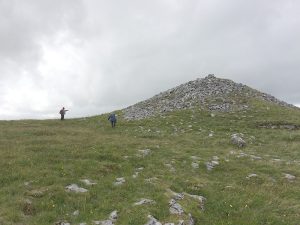
Further, other stories grew to describe the Tuatha de Danaan as retreating to the Under or Nether worlds, under the earth, or hidden in magic in realms just beyond our collective perceptions. Some stories describe the Tuatha De Danaan as wrapping themselves away cloaked in magic in the most beautiful parts of Ireland, continuing to live side by side the Irish people, living long and beautiful lives. In time the poetic description became the ‘People of the Sidne’ (pronounced Shee) – meaning the ‘people under the mound’ referring to all the burial mounds from that age found atop all the peaks around Ireland. In language, Gaelic and old English, they became to be referred to as the Fae, historically meaning ‘People with magical powers’ And the place where they lived became to be referred to as the Faery, an Anglo-French word meaning the Land of the Fae (or fay, or fee), a realm otherwise known as the Land of Enchantment.
The word ‘Faery’ originated and evolved in indeterminate ways before arriving in Ireland, from ancient Greece, across early European lands, Germany, France, England and cultures, and finally settling in ancient Ireland. Over time and travels, it came to mean the home of the fae, collecting all sorts of incarnations and forms living there during its evolution, Elves and Dwarves, and Pixies and Leprechaums, and Trolls and Goblins, Merpeople and Silkies, Brownies, Asrai and dozens of other similar namings. Amidst all this, when the Tuatha de DaNaan fled to the Faery, they became known as the Fairies like no other fledglings before then, a uniquely Irish origin. That origin has since backwashed primarily to Scotland, and England, and France and elsewhere, but the tale of Fairies took root and matured in Ireland with the Tuatha de Danaan. In other words, Tinkerbell’s ancestors are the Tuatha de Danaan
Storywise, through centuries of repeated and evermore embellished descriptions and imaginings, the stories of the Tuatha De Danaan evolved into many multiple tales of fairies, ‘fairytales’ which involved them as both the Celtic Gods with heroic battles, loves and lessons… and as imaginative stories of fairies all through the countryside, good and bad. Overall the Faery (the land of enchantment) is described as a place where time moves slowly or stands still, filled with youthful eternal beings or at least of very long living, where beauty is unparalleled, music unmatched in its harmonies, where magic embues the air like dust. It is a suprahuman existence and dangerous for mortal folk, hence the numerous fairytales of heroes disappearing into the Faery where some return as if from dreams, some do not, and some only reappear for a while and then to return forever. Overall it is advised to avoid the Faery, the places of and the fair folk themselves, and never, ever step into a mushroom ring, a common way of ensnaring common folk into the Faery (where they become enchanted with music, wine, song and dance)!
Todays most common fairies are an 18th & 19th centuries Victorian interpretation, Tinkerbell’s cousins, fairies of an indeterminate generally prepubescent age involved in all kinds of creative and interactive activities. Generally they are described as some combination of playful, pricklish, spiteful, capricious, quick to insult, helpful or not, moody, sometimes dangerous, overall tricky, and overall symbolize the spiritual qualities of childhood, femininity, beauty and innocence in all its shapes and forms. But Tinkerbell is only one end of the spectrum of fairies, who themselves are one end of the spectrum of the fae. The Tuatha de Danaan are the backdrop of that entire spectrum.
For further reading – https://faeryfae.com/more-on-the-tuatha-de-danaan/