

About Queen Maev and Queen Mab
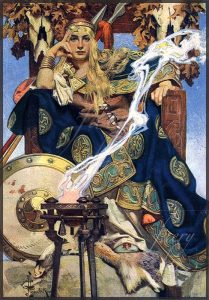
by Joseph Christian Leyendecker (1874 – 1951)
Published ‘Celtic Myths and Legends’ (1911)
Recently I have created a couple of cards based on artist images of Queen Maev and Queen Mab. In doing so I realized there is some overlap in these two figures and thought I would clarify their respective histories. In short, there has been some speculation that the spelling of ‘Mab’ is a derivative of Maev, and that they are basically one and the same. The truth however is distinctly different, and they, Meav and Mab could not be more different.
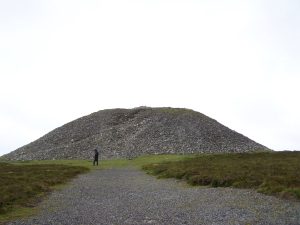
To begin with, Queen Maev, historically spelled ‘Medb’, (old irish) and also spelled ‘Maeve, Maev, Mave or Maiv’ was a 7th – 12th (according to earliest written records) century Irish queen, or from the Ulster Cycle of Irish mythology. Much of her story is both history and myth. Naturally the truth of things lies somewhere in the murky middle, and is all a matter of interpretation. Most likely there was a historical figure that existed and many accounts of her activities. Most striking is, in County Sligo there is a 40 ft high stone cairn on the summit of Knocknarea, where she is supposedly buried, standing up, facing any enemies.
There is also a substantial amount of myth surrounding her, probably due to the traditional storytelling and embellishments of the times. She was described as a ‘fair haired wolf queen’ strong and beautiful. Her name ‘Mead’ is said to mean ‘one who intoxicates’ and possibly based on the English word ‘meade’. She had seven sons, two daughters, several marriages, many lovers, and a longstanding quarrel with her first husband, the King of Ulster. Maev was strong-willed, ambitious, cunning, ruthless and promiscuous, and is overall interpreted as an archetypal warrior queen. One of her primary exploits is the story of the Cattle Raid of Cooley, where she declared war to gain possession of a stud bull, to add to and equal her wealth with that of her then husband Ailill. The story myth is involved and deeply embedded in Irish Mythology, and can be referenced here.


In closing this discussion of Maev (Mebd), this mythological figure rooted somewhere in the past represents woman’s power, noting her sexual strength, political influence and role in the balances of power with kings, a traditional role of the archetypal queen. Some speculations say that she was a purely allegorical figure, representing the place and roles of queens in ancient Ireland, while the truth lies somewhere in the mists of time.
On the other hand, Queen Mab is a very different creature. Mab is a diminutive fairy from the Shakespeare play Romeo and Juliet. She is known for being the ‘fairies midwife’ and bringing birth to dreams, performing pranks upon sleepers, ‘delivering the fancies of sleeping men‘. She is also known to be a prankster, but otherwise of a harmless nature, other than being a ‘dream-bringer’ and all that that entails. Queen Mab also appears in later literature throughout the 1700 and 1800’s, especially poetry, and in various forms of contemporary writing, including books, music and screenwriting.
That said, I will add that Mab has a very unique magic about her, delivering dreams. She is known as a ‘Night Fairy’ which is a fairy that mostly or only comes out at night. In general, night fairies are responsible for ‘signs of the night’, such as encouraging peaceful sleep, caring of animals and humans at rest, healing, guiding through all darknesses and other helpful actions from throughout the night. Mab however is a queen of this realm, due to her ability to birth and color dreams, of all types, hence her reputation of being a prankster, since dreams come in all flavors. Some fairies can enter dreams, a rare magic, but Mab’s magic is unique to her and perhaps a few other night fairies. In any case, she is truly queen of the night, with all its shadows and silences and recesses, working behind the scenes while we sleep.